Built from a decade working inside real homes, backed by a philosophy that takes that work seriously.


About Elizabeth Stelzer, founder of Jigsaw Home Systems.
I’ve spent over ten years working inside private households across Massachusetts, Vermont, and Montréal—as a nanny, a household manager, a family support worker, a house cleaner, an organizer, and everything in between. The homes looked nothing alike, and the families had completely different needs, routines, and ways of living.
What stayed consistent was how much the genuine relationship behind my role(s) mattered—to the kids, parents, professionals, and the overall fabric of home and family life.
I’ve witnessed the impacts of whole-home support firsthand, in ways big and small. Often, this shows up as relief: a client who has a difficult day at work and comes home to a clean kitchen and dinner prepped, freeing up their evening. A client who can lean on me to streamline a move, or a client who can confidently rely on me as a steady presence for their child during a separation.
I hold an M.A. in Education & Society from McGill University, where my research examined quality in early childhood settings as a relational process rather than a universal standard. I spent years analyzing quality (e.g., high-quality education, high-quality service) as connected to our environment: the people, settings, and experiences that comprise everyday life. You can find my research here.
This time taught me how to think systemically, read between the lines, and recognize patterns. It also taught me that effective solutions to real-life issues require embracing complexity instead of trying to flatten it. My graduate training serves as a rigorous, research-backed foundation for how I approach whole-home support: from a place of integrity, committed to understanding your home as a complex ecosystem rather than a problem that needs to be solved.
This framing is at the heart of Jigsaw; there is no one-size-fits-all answer, only what works for this household, these people, right now.
I don’t arrive with a predetermined plan. I show up consistently, pay close attention, and apply my knowledge and skill set to your specific situation, building something that works for your home, your goals, and your way of living.
Jigsaw is proudly neurodivergent-friendly. I have ADHD. I know firsthand that effective systems have to work with how your brain operates, and that frequently, what’s effective for neurodivergent brains looks different than what we’ve been told ‘should work.’
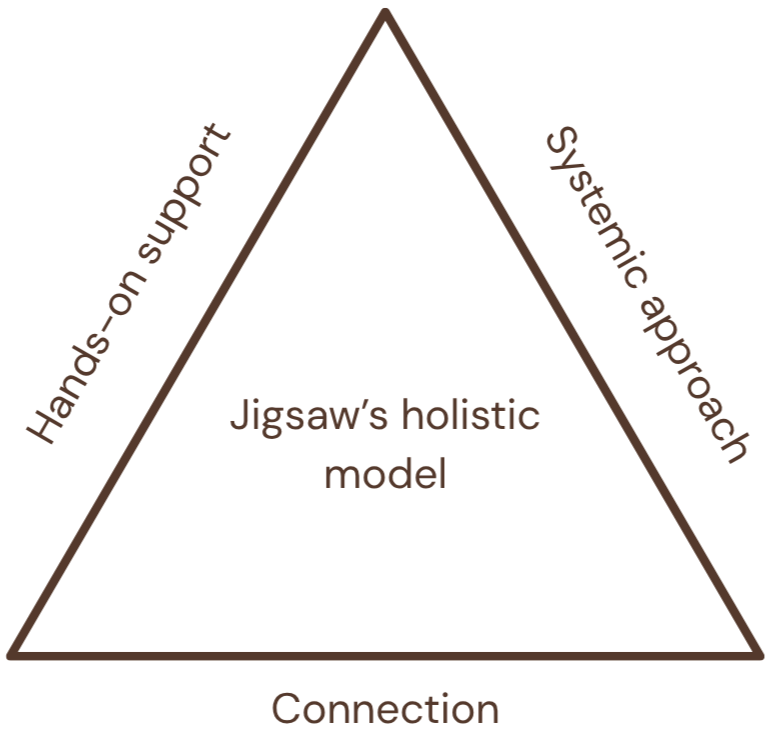
Jigsaw provides holistic whole-home support by focusing on three areas. Learn more about the three focus areas below.
-
What you typically imagine when you hear domestic titles like ‘housekeeper’ or ‘nanny.’
Systematic (task-focused) support, such as:
Cleaning and organizing
Laundry
Meal prep
Childcare
-
Supporting the ‘big picture’ of a household, focused on understanding how clients actually live in their space.
If hands-on support is that ‘what,’ this is the ‘why.’
This includes noticing patterns, contextualizing behaviour within the client’s wider life, and anticipating pressure points.
Examples:
Noticing that lack of time isn’t the reason a client struggles with laundry, but that their current system doesn’t work for how the client moves through their day
Awareness of how a client’s work schedule, energy levels, or personal circumstances affect what kind of support is useful on which days
Recognizing that a client always struggles after travel or a busy social period, and proactively adjusting support to prevent burn-out
-
Jigsaw’s approach works because at the heart of the support is an intentional relationship that gradually deepens over time.
Trust and respect are paramount to showing up for you effectively, and Jigsaw’s approach understands that you cannot speed-track building trust.
The engagement is more fulfilling and impactful because it’s rooted in curiosity, genuine care, and years of research and hands-on experience.
Domestic work is one of the least regulated industries out there. There are no licensing requirements, no standardized trainings, and no oversight body that sets expectations for quality or conduct. Domestic titles are also unprotected, so anyone can call themselves a housekeeper, a nanny, or a household manager.
This creates problems for everyone. Clients have no reliable way to assess service or ensure accountability, and workers have no professional framework to stand behind, no protection from exploitation, and little recognition of the skill and expertise their work requires.
The result is a market defined by inconsistency, devaluation, and a chronic mismatch between what clients and providers need and what they’re able to find.
Jigsaw exists inside this gap—not as a fix for a broken system, which is a much larger problem, but as one example of what this work looks like when it’s taken seriously.